
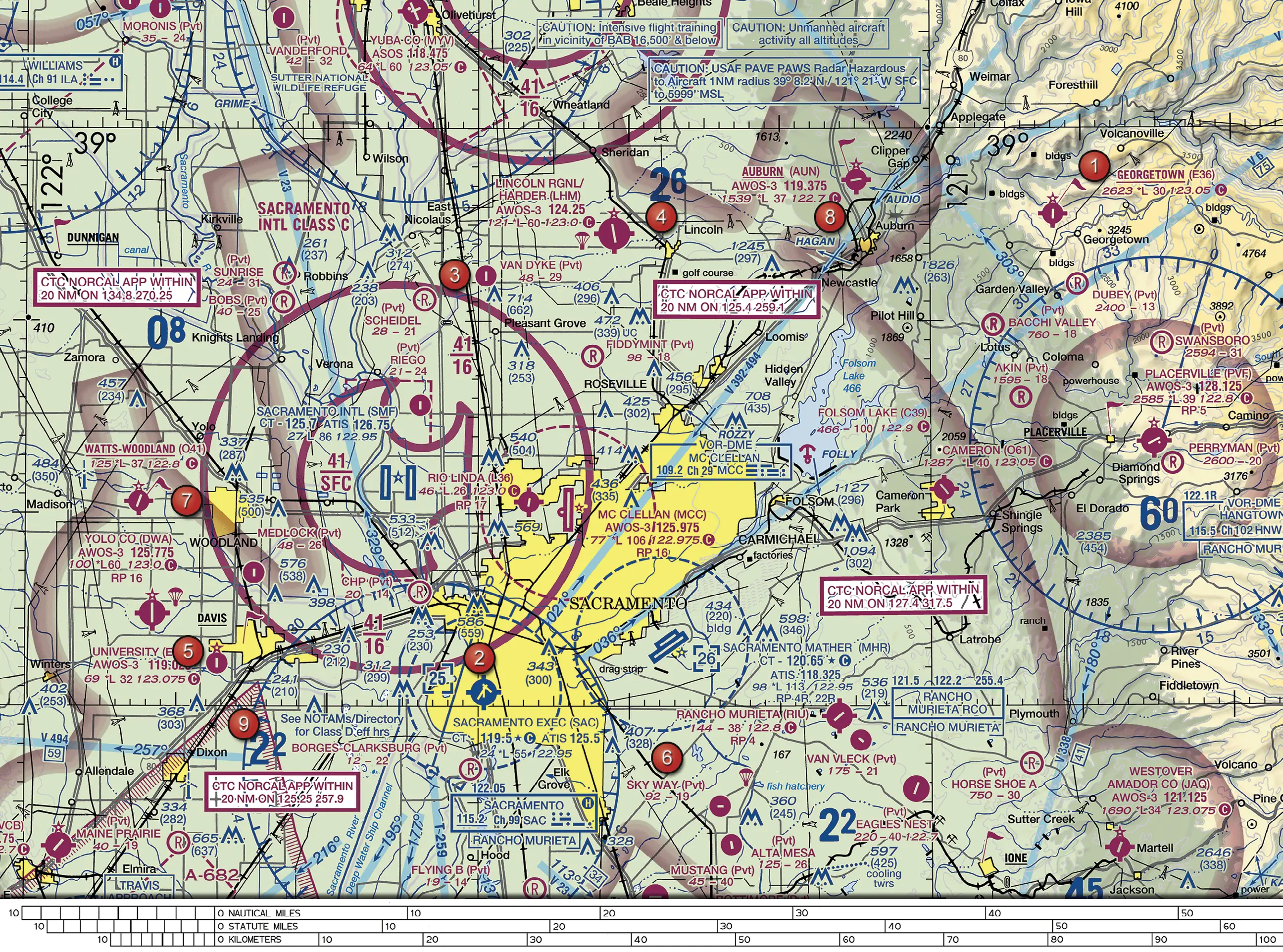
(Refer to Figure 71.) Near the bottom of the figure, south-east of Eagles Nest (Pvt), an obstacle group is charted 597 over (425) with a short descriptive label. On a calm, cold morning, a remote pilot will survey a field next to it at 300 feet AGL and sees no plume above the structures. What should the pilot assume?
- AThey are cooling towers; an invisible exhaust plume may still cause turbulence, so the airspace near them needs caution
- BThey are cooling towers; with no visible plume they are not operating, so only a collision with the towers matters
- CThey are wind turbines; only their unlit blade tips, which can reach 300 feet above the lights, need extra clearance
Show answer and explanation
Correct answer: A. They are cooling towers; an invisible exhaust plume may still cause turbulence, so the airspace near them needs caution
The obstacle group 597 (425) is labeled cooling twrs. Cooling towers emit exhaust plumes that can cause turbulence and vertical shear. A plume may be invisible, and stacks without a visible plume may still be operating, so the remote pilot should treat the airspace near them with caution, especially in calm, cold air at low altitude.
- A. Correct. The label reads cooling twrs. The AIM says stacks without visible plumes may still be in full operation and the airspace nearby should be treated with caution; the hazard is greatest at low altitude in calm, cold air.
- B. Incorrect. Wrong. The AIM warns that a plume may have invisible characteristics and that stacks without visible plumes may still be in full operation.
- C. Incorrect. Wrong. The chart labels this group cooling twrs and shows no wind turbine symbols or wind farm outline there.
Marked on Figure 71: Cooling towers 597 (425) south-east of Eagles Nest.
Aeronautical Information Manual (AIM), Basic with Changes 1, 2 and 3, 7-6-16b Exhaust stacks without visible plumes may still be in full operation, and airspace in the vicinity should be treated with caution.
Aeronautical Information Manual (AIM), Basic with Changes 1, 2 and 3, 7-6-16a These hazards are most critical during low altitude flight in calm and cold air, especially in and around approach and departure corridors or airport traffic areas.