A short practice set across the knowledge areas of the FAA Remote Pilot (UAG) test. Pick an answer, then open the explanation. It shows why each option is right or wrong and which FAA document it comes from.
These are practice questions written from official FAA publications. They are not questions from the FAA knowledge test. The real test has 60 scored questions in 2 hours, and 70% is needed to pass.
1.Regulations
A friend who does not hold a remote pilot certificate wants to fly your small UAS during a part 107 operation. Under which condition may your friend manipulate the flight controls?
AOnly if a visual observer is also present during the flight
BOnly if the small unmanned aircraft weighs 0.55 pounds or less
CYour friend is under the direct supervision of a remote PIC who can immediately take direct control of the flight
Show answer and explanation
Correct answer: C. Your friend is under the direct supervision of a remote PIC who can immediately take direct control of the flight
A person without a remote pilot certificate may manipulate the flight controls only under the direct supervision of a remote PIC who has the ability to immediately take direct control of the flight (§107.12(a)(2)).
A. Incorrect. A visual observer does not replace the requirement for direct supervision by a remote PIC who can immediately take control.
B. Incorrect. §107.12(a) contains no weight exception for manipulating the flight controls.
C. Correct. §107.12(a)(2) allows this when the remote PIC can immediately take direct control of the aircraft.
Which knowledge area is covered by the initial aeronautical knowledge test and recurrent training under §107.73, but is not listed for the training taken by part 61 pilots under §107.74?
AOperation at night
BEmergency procedures
CRadio communication procedures
Show answer and explanation
Correct answer: C. Radio communication procedures
§107.73 lists radio communication procedures among the areas of the initial test and recurrent training. The §107.74 training for part 61 pilots covers regulations, weather effects, loading, emergency procedures, crew resource management, performance, maintenance and preflight inspection, and operation at night, but not radio communication procedures.
A. Incorrect. Operation at night appears in both lists: §107.73(m) and §107.74(h).
B. Incorrect. Emergency procedures appear in both lists: §107.73(e) and §107.74(d).
C. Correct. §107.73(g) lists radio communication procedures, and the §107.74 list does not include it.
A real estate agent who hired a remote pilot stands beside the control station to watch the live video. The agent has no task in the flight. Is the agent a direct participant whom the remote PIC must brief under §107.49(b) before the flight?
AYes, because everyone standing at the control station is a direct participant
BYes, because the agent hired the remote pilot for the operation
CNo, because a direct participant is a person whose involvement is necessary for the safe operation of the small UAS
Show answer and explanation
Correct answer: C. No, because a direct participant is a person whose involvement is necessary for the safe operation of the small UAS
§107.49(b) requires the remote PIC to brief all persons directly participating in the operation. AC 107-2A 5.1 says a person is a direct participant if his or her involvement is necessary for the safe operation of the small UAS. A client who only watches the video has no such role.
A. Incorrect. Wrong. AC 107-2A 5.1 defines a direct participant by whether the person's involvement is necessary for safe operation, not by where the person stands.
B. Incorrect. Wrong. Hiring the pilot does not make the agent a direct participant. AC 107-2A 5.1 ties the term to involvement necessary for safe operation.
C. Correct. AC 107-2A 5.1: a person is a direct participant if his or her involvement is necessary for the safe operation of the small UAS. The agent has no such role.
Source
AC 107-2A Small Unmanned Aircraft Systems (sUAS), 5.1
A manufacturer's small unmanned aircraft can be switched between a Category 2 mode and a mode not eligible for operations over people. Under §107.120(b)(2), what must its remote pilot operating instructions address, at a minimum?
AHow to verify and change the mode or configuration of the system
BThe names of the remote pilots allowed to fly the aircraft
CA log of every Category 2 flight the aircraft has made
Show answer and explanation
Correct answer: A. How to verify and change the mode or configuration of the system
§107.120(b)(2) requires remote pilot operating instructions that address, at a minimum, a system description, modifications that will not change eligibility, and instructions for how to verify and change the mode or configuration if they are variable.
A. Correct. §107.120(b)(2)(iii) requires instructions for verifying and changing a variable mode or configuration.
B. Incorrect. §107.120(b)(2) lists a system description, allowable modifications, and mode instructions, not a list of pilots.
C. Incorrect. A flight log is not among the minimum contents listed in §107.120(b)(2).
A remote pilot plans a part 107 flight near a wildfire where flight restrictions have been designated by a Notice to Airmen. What does §107.47 require of the remote PIC regarding such areas?
AComply with §§91.137 through 91.145 and 99.7
BNothing, because part 91 flight restrictions apply only to manned aircraft
CComply with the restrictions only when flying higher than 400 feet AGL
Show answer and explanation
Correct answer: A. Comply with §§91.137 through 91.145 and 99.7
Under §107.47, a person acting as a remote pilot in command must comply with the provisions of §§91.137 through 91.145 and 99.7 on flight restrictions in the proximity of certain areas designated by notice to airmen.
A. Correct. §107.47 requires a person acting as remote PIC to comply with §§91.137 through 91.145 and 99.7.
B. Incorrect. §107.47 expressly makes §§91.137 through 91.145 and 99.7 apply to the remote PIC.
C. Incorrect. §107.47 contains no altitude condition; the remote PIC must comply with the listed sections.
A remote pilot plans a part 107 flight in a Defense Area. Section 107.47 requires compliance with §99.7. What does §99.7 require of the pilot?
ACompliance only with the part 107 operating rules, because part 99 does not apply to small UA
BCompliance with special security instructions issued by the Administrator in the interest of national security, in addition to the applicable rules of part 99
CObtaining written permission from the nearest military base commander before every flight
Show answer and explanation
Correct answer: B. Compliance with special security instructions issued by the Administrator in the interest of national security, in addition to the applicable rules of part 99
§99.7 requires each person operating an aircraft in an ADIZ or Defense Area to comply, in addition to the applicable rules of part 99, with special security instructions issued by the Administrator in the interest of national security under agreements with the Department of Defense or a U.S. Federal security or intelligence agency.
A. Incorrect. Wrong. §107.47 requires remote pilots to comply with §99.7, which applies to each person operating an aircraft in an ADIZ or Defense Area.
B. Correct. §99.7 requires each person operating an aircraft in an ADIZ or Defense Area to comply with such special security instructions in addition to the applicable rules of part 99.
C. Incorrect. Wrong. §99.7 requires compliance with special security instructions issued by the Administrator; it does not describe permission from a base commander.
Source
14 CFR §§91.137-91.145 and §99.7 flight restrictions (eCFR), §99.7
To protect the label from scratches, a remote pilot places the aircraft's registration number only inside the battery compartment, where it is hidden when the battery is installed. Does this meet part 48 marking rules for a part 107 flight?
AYes, because the number is permanently attached to the aircraft
BYes, if the Certificate of Aircraft Registration is carried at the control station
CNo, because the unique identifier must be legibly displayed on an external surface of the aircraft
Show answer and explanation
Correct answer: C. No, because the unique identifier must be legibly displayed on an external surface of the aircraft
A registered small unmanned aircraft may not be operated unless it displays its unique identifier as §48.205 requires, which includes legible display on an external surface. A number hidden inside the battery compartment does not meet that rule.
A. Incorrect. Wrong. Being attached is not enough; §48.205(c) also requires the unique identifier to be displayed on an external surface.
B. Incorrect. Wrong. Carrying the certificate does not replace marking; §48.200(a) forbids operating a registered aircraft unless it displays the unique identifier per §48.205.
C. Correct. §48.205(c) requires the unique identifier to be legibly displayed on an external surface of the small unmanned aircraft.
Source
14 CFR Part 48 Registration and Marking Requirements for Small Unmanned Aircraft (eCFR), §48.205(c)
14 CFR Part 48 Registration and Marking Requirements for Small Unmanned Aircraft (eCFR), §48.200(a)
A remote pilot prepares a request for a certificate of waiver under part 107. According to §107.200, what must the request contain?
AProof of liability insurance for the operation and a copy of the aircraft's purchase receipt
BA complete description of the proposed operation and justification that it can safely be conducted under the waiver
CA logbook endorsement from a certificated flight instructor for the remote pilot in command
Show answer and explanation
Correct answer: B. A complete description of the proposed operation and justification that it can safely be conducted under the waiver
A request for a certificate of waiver must contain a complete description of the proposed operation and justification that establishes that the operation can safely be conducted under the terms of a certificate of waiver (§107.200(b)).
A. Incorrect. §107.200(b) does not list insurance or receipts; it requires a description of the operation and a safety justification.
B. Correct. §107.200(b) requires a complete description of the proposed operation and a justification that establishes it can safely be conducted.
C. Incorrect. §107.200(b) does not require an instructor endorsement.
A small unmanned aircraft's motor begins to fail over a city block, and the remote PIC must deviate from part 107 to get it down at once. One choice is a crowded parking lot; another is an empty grass lot the aircraft can still reach. According to AC 107-2A, how should the emergency action be taken?
AIn a way that minimizes injury or damage to property, such as landing in the empty lot
BBy landing at the nearest point, because any action is acceptable once an emergency exists
COnly after asking the FAA for permission to deviate from the rules
Show answer and explanation
Correct answer: A. In a way that minimizes injury or damage to property, such as landing in the empty lot
In an in-flight emergency the remote PIC may deviate from part 107 to the extent necessary to meet it (§107.21). AC 107-2A 5.18 adds that emergency action should be taken in such a way as to minimize injury or damage to property, so the empty lot is the better choice.
A. Correct. AC 107-2A 5.18: emergency action should be taken in such a way as to minimize injury or damage to property.
B. Incorrect. Wrong. The deviation is allowed only to the extent necessary (§107.21(a)), and AC 107-2A 5.18 says the action should minimize injury or damage to property.
C. Incorrect. Wrong. §107.21(a) lets the remote PIC deviate in an in-flight emergency requiring immediate action. A written report is due only upon request (§107.21(b)).
Source
AC 107-2A Small Unmanned Aircraft Systems (sUAS), 5.18
A remote pilot will fly a roof inspection at 11 a.m. on a clear day. The aircraft's anti-collision light is broken. According to AC 107-2A, does §107.29 require working anti-collision lighting for this flight?
AYes, because anti-collision lighting is required for every part 107 flight
BNo, because §107.29 does not require lit anti-collision lighting during the day, though the pilot may choose to use it
CYes, unless the flight stays within 400 feet of the remote pilot
Show answer and explanation
Correct answer: B. No, because §107.29 does not require lit anti-collision lighting during the day, though the pilot may choose to use it
AC 107-2A paragraph 5.7.2.2 states that §107.29 does not require small unmanned aircraft operating during the day to have lit anti-collision lighting, although remote pilots may choose to use lighting in daytime.
A. Incorrect. Wrong. The lighting requirement in §107.29 applies to night and civil twilight, not to daytime operations.
B. Correct. AC 107-2A says §107.29 does not require lit anti-collision lighting during the day, and pilots may elect to have lighting on.
C. Incorrect. Wrong. No such distance condition exists; daytime operations simply do not require lit anti-collision lighting under §107.29.
Source
AC 107-2A Small Unmanned Aircraft Systems (sUAS), 5.7.2.2
AC 107-2A Small Unmanned Aircraft Systems (sUAS), 5.7.2.2
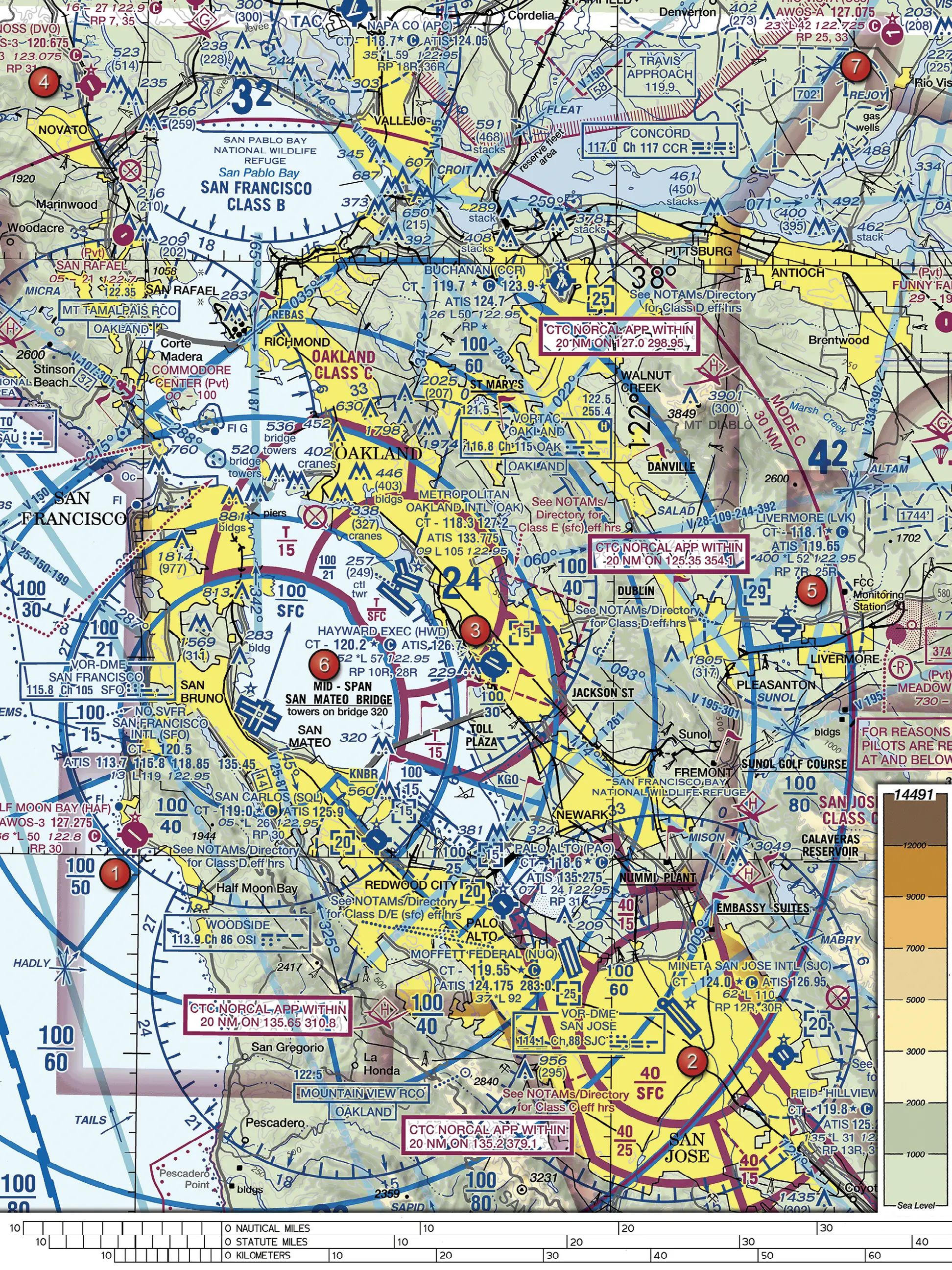
(Refer to Figure 70.) Over the bay just south-east of the word 'piers', a sector of the Oakland Class C is labeled with a magenta T over 15. What does the T indicate?
Figure 70, FAA Airman Knowledge Testing Supplement (FAA-CT-8080-2H). Open full size to zoom. Not for navigation.
AThe sector is a Terminal Radar Service Area rather than Class C airspace
BThe Class C in that sector is temporary and active only when announced by NOTAM
CThe Class C extends up to, but not including, the floor of the overlying Class B airspace
Show answer and explanation
Correct answer: C. The Class C extends up to, but not including, the floor of the overlying Class B airspace
Class C sector altitudes are shown in magenta as ceiling over floor. A ceiling of T means the Class C goes up to, but not including, the floor of the overlying Class B airspace; here the floor is 1,500 feet MSL.
A. Incorrect. TRSAs are shown with screened black lines and black altitude figures; this magenta label is a Class C sector ceiling.
B. Incorrect. T is a ceiling value, not a note about temporary activation.
C. Correct. A Class C ceiling value of T means the ceiling is to, but not including, the floor of the overlying Class B airspace.
Marked on Figure 70: Oakland Class C sector T/15 south-east of 'piers'.
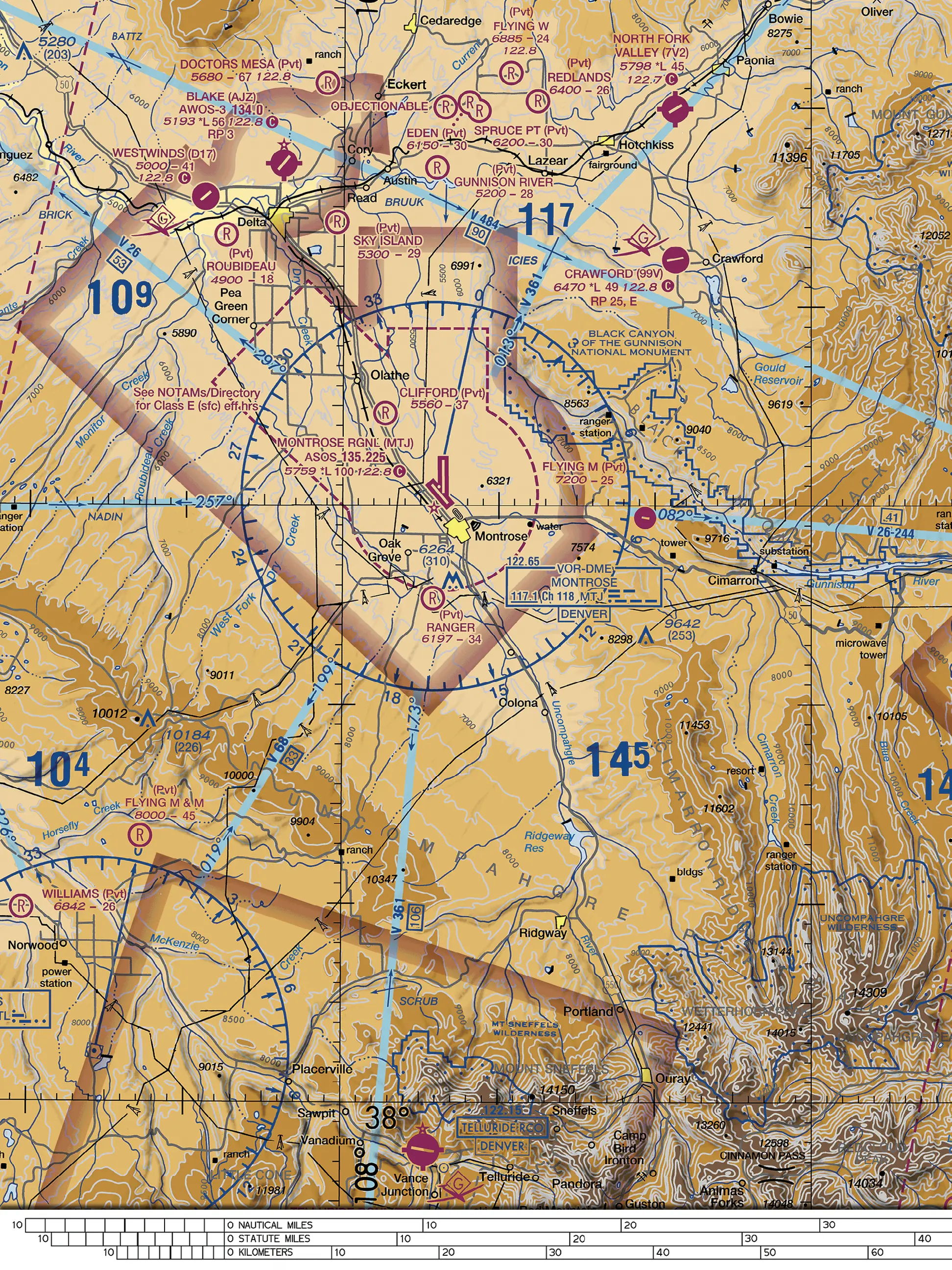
(Refer to Figure 80.) Just southwest of Westwinds Airport (D17), near Delta, a magenta flag symbol containing the letter G is printed. What should a remote pilot planning a flight there expect?
Figure 80, FAA Airman Knowledge Testing Supplement (FAA-CT-8080-2H). Open full size to zoom. Not for navigation.
AHang glider activity
BGlider operations
CUltralight activity
Show answer and explanation
Correct answer: B. Glider operations
The sectional legend identifies the magenta G symbol as Glider Operations, so a remote pilot planning a flight near Westwinds and Delta should expect gliders in the area.
A. Incorrect. Hang glider activity has its own legend symbol; the G symbol is used for glider operations.
B. Correct. The sectional legend identifies the G symbol as Glider Operations.
C. Incorrect. Ultralight activity is shown with a different legend symbol, not a G.
Marked on Figure 80: Glider symbol near Westwinds (D17).
Source
FAA-CT-8080-2H Airman Knowledge Testing Supplement, Legend 1, Airport Traffic Service and Airspace Information
How is a temporary flight restriction (TFR) put in place, and what should a remote pilot do about TFRs before each flight?
AIt is printed on the current sectional chart; check the chart legend.
BIt is designated by a flight data center (FDC) NOTAM; check NOTAMs before each flight.
CIt is listed in the Chart Supplement U.S.; checking it once per edition is enough.
Show answer and explanation
Correct answer: B. It is designated by a flight data center (FDC) NOTAM; check NOTAMs before each flight.
A TFR is designated by a flight data center (FDC) NOTAM. AC 107-2A tells the remote PIC to check for NOTAMs before each flight to determine whether any airspace restrictions apply.
A. Incorrect. Wrong. A TFR is designated by an FDC NOTAM, not by a chart, so the pilot must check NOTAMs.
B. Correct. An FDC NOTAM designates a TFR, and the remote PIC must check NOTAMs before each flight.
C. Incorrect. Wrong. A TFR is designated by an FDC NOTAM, and NOTAMs must be checked before each flight.
Source
FAA-G-8082-22 Remote Pilot – sUAS Study Guide, Chapter 2, Temporary Flight Restrictions (TFR)
AC 107-2A Small Unmanned Aircraft Systems (sUAS), 5.10.3
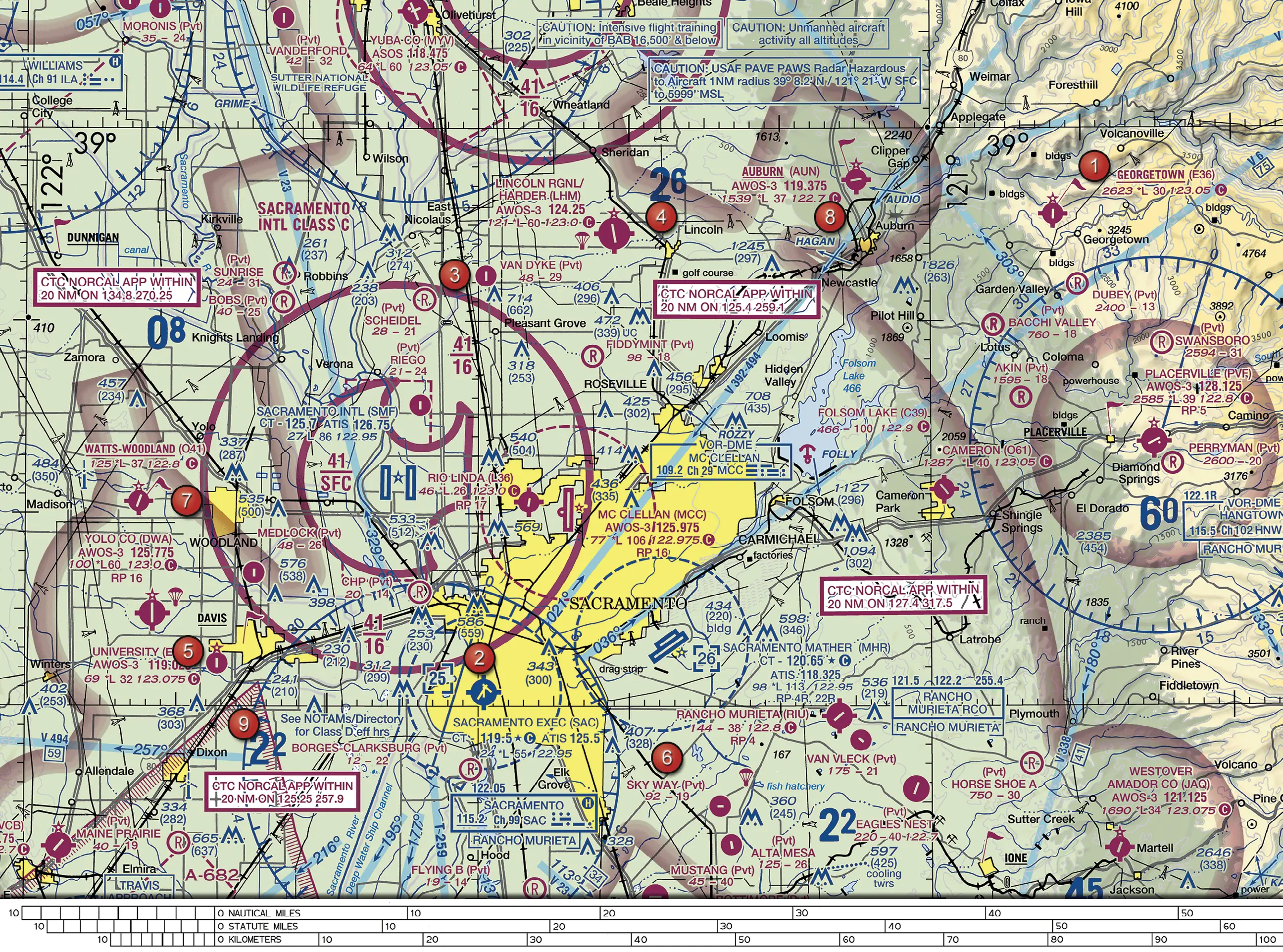
(Refer to Figure 71.) Near Pleasant Grove, east-northeast of Sacramento International, the Class C sector is labeled 41 over 16. The ground there is about 50 feet MSL. A remote pilot flies at 400 feet AGL. Where is the aircraft relative to the Class C airspace?
Figure 71, FAA Airman Knowledge Testing Supplement (FAA-CT-8080-2H). Open full size to zoom. Not for navigation.
AInside it, because everything within the outer Class C circle begins at the surface
BInside it, because the aircraft is below the Class C ceiling of 4,100 feet MSL
CBelow it, because the Class C floor in this sector is 1,600 feet MSL
Show answer and explanation
Correct answer: C. Below it, because the Class C floor in this sector is 1,600 feet MSL
Class C figures show the MSL ceiling over the MSL floor with the last two zeros removed. 41 over 16 is 1,600 to 4,100 feet MSL. The aircraft at about 450 feet MSL is below this shelf, so it is not in the Class C airspace.
A. Incorrect. Only sectors labeled SFC begin at the surface. This sector has a floor of 16, which is 1,600 feet MSL.
B. Incorrect. Being below the ceiling is not enough. The aircraft must also be above the floor, which here is 1,600 feet MSL.
C. Correct. 41 over 16 means Class C from 1,600 to 4,100 feet MSL. At about 450 feet MSL (50 + 400) the aircraft is under the shelf.
Marked on Figure 71: Sacramento Intl Class C shelf 41/16 near Pleasant Grove.
Source
FAA Chart Users' Guide (Aeronautical Chart User's Guide), complete, VFR Terms and Symbols, Airspace: Class C
A remote pilot is operating in clear air a few miles from a large thunderstorm. According to the Aviation Weather Handbook, what should the pilot know about hail?
AHail falls only directly beneath the storm's rain shaft
BHailstones may be encountered in clear air several miles from the thunderstorm
CRain at the surface shows that no hail is present aloft
Show answer and explanation
Correct answer: B. Hailstones may be encountered in clear air several miles from the thunderstorm
Large hail forms in severe thunderstorms with strong updrafts. The hailstones can fall in clear air several miles from the storm, and pilots should expect hail with any thunderstorm, especially beneath the anvil.
A. Incorrect. The AWH states hailstones may be encountered in clear air several miles from the thunderstorm.
B. Correct. Hail can fall in clear air several miles from the storm, especially beneath the anvil.
C. Incorrect. The AWH states that rain at the surface does not mean the absence of hail aloft.
A remote PIC is planning a flight with a visual observer and a separate person manipulating the controls. According to the FAA study guide, what is crew resource management (CRM) focused on?
AThe effective use of all available resources: human resources, hardware, and information
BReducing the crew so the remote PIC performs every task personally
CImproving only the control stick skills of the person manipulating the controls
Show answer and explanation
Correct answer: A. The effective use of all available resources: human resources, hardware, and information
CRM training focuses on the effective use of all available resources (human resources, hardware, and information) to support ADM, crew cooperation, and decision-making.
A. Correct. CRM focuses on the effective use of all available resources to support crew cooperation and better decisions.
B. Incorrect. CRM is about using all available resources, including human resources, not removing them.
C. Incorrect. CRM covers human resources, hardware, and information that support decision-making, not stick skills alone.
Source
FAA-G-8082-22 Remote Pilot – sUAS Study Guide, Chapter 10, History of ADM
Near a non-towered airport, a remote pilot hears a manned pilot ask the UNICOM for an advisory. The UNICOM operator replies with the wind direction and says runway 27 is recommended. What is the UNICOM operator doing?
AIssuing a landing clearance that the manned pilot must follow
BGiving requested airport information, such as wind direction and a recommended runway
CApproving the remote pilot's operation near the runway 27 approach path
Show answer and explanation
Correct answer: B. Giving requested airport information, such as wind direction and a recommended runway
UNICOM stations may give pilots weather, wind direction and a recommended runway on request. For a remote pilot listening in, this call is a useful clue that arriving traffic will likely use runway 27.
A. Incorrect. Wrong. UNICOM is a nongovernment station, not ATC; it gives information on request, not clearances.
B. Correct. On pilot request, UNICOM stations may provide weather, wind direction, the recommended runway, or other necessary information.
C. Incorrect. Wrong. UNICOM does not approve small UA operations; it gives airport information to pilots who request it.
Source
FAA-H-8083-25C Pilot's Handbook of Aeronautical Knowledge, Chapter 14, Nontowered Airport
A remote pilot finished two beers at 2200. At 0530 the next morning, the pilot's blood alcohol level is 0.01 percent. May the pilot act as remote PIC at 0530?
AYes, because the blood alcohol level is below 0.04 percent
BNo, because 8 hours have not passed since drinking alcohol
CYes, because alcohol rules apply only to manned aircraft pilots
Show answer and explanation
Correct answer: B. No, because 8 hours have not passed since drinking alcohol
§107.27 applies §§91.17 and 91.19 to the remote PIC. Part 91 requires blood alcohol below .04 percent and 8 hours between drinking and piloting. From 2200 to 0530 is only 7.5 hours, so the pilot may not fly yet.
A. Incorrect. Wrong. Even with blood alcohol well below .04 percent, a pilot cannot fly sooner than 8 hours after drinking alcohol.
B. Correct. Only 7.5 hours have passed; both the 8-hour and the .04 percent limits must be met.
C. Incorrect. Wrong. §107.27 makes the remote PIC comply with §§91.17 and 91.19.
Source
14 CFR Part 107 (eCFR), §107.27
FAA-G-8082-22 Remote Pilot – sUAS Study Guide, Chapter 9, Alcohol
Using the Perceive, Process, Perform (3P) model, a remote pilot has perceived the hazards of a planned flight with the PAVE checklist. According to the FAA study guide, which checklist is used for the next step, processing those hazards?
Correct answer: B. CARE: Consequences, Alternatives, Reality, External factors
The 3P model combines three checklists: pilots perceive hazards with PAVE, process them with CARE (Consequences, Alternatives, Reality, External factors), and perform risk management with TEAM (Transfer, Eliminate, Accept, or Mitigate).
A. Incorrect. TEAM is the choice list used in the perform step, to carry out risk management.
B. Correct. Pilots process hazards by using the CARE checklist.
C. Incorrect. IMSAFE is a personal readiness checklist for the pilot, not the checklist the 3P model pairs with processing hazards.
Source
FAA-G-8082-22 Remote Pilot – sUAS Study Guide, Chapter 10, Perceive, Process, Perform (3P) Model
FAA-G-8082-22 Remote Pilot – sUAS Study Guide, Chapter 10, Perceive, Process, Perform (3P) Model
Before a job, a remote pilot says the waiver conditions and the company's checklist are "silly and unnecessary" and that no one should tell an experienced pilot what to do. Which hazardous attitude does this show?
AAnti-authority
BResignation
CImpulsivity
Show answer and explanation
Correct answer: A. Anti-authority
Resenting direction and treating rules and procedures as silly or unnecessary is the anti-authority attitude ("Don't tell me"). Its antidote is to follow the rules, which are usually right.
A. Correct. The FAA describes anti-authority as resenting being told what to do and regarding rules, regulations, and procedures as silly or unnecessary.
B. Incorrect. Resignation is the "What's the use?" attitude of a pilot who feels unable to make a difference and leaves action to others.
C. Incorrect. Impulsivity is the urge to do something immediately without stopping to think, not resentment of rules.
Source
FAA-H-8083-25C Pilot's Handbook of Aeronautical Knowledge, Chapter 2, Hazardous Attitudes and Antidotes (Figure 2-4)
Remote Pilot Ace has topic practice, full 65-question mock exams in the test format, zoomable figures and an explanation with its source for every answer. Free to start.
Coming soon to the App Store and Google Play. About the app