Radio communication, airport operations, emergency procedures, crew resource management and aeronautical decision-making. 15 free questions with answers and explanations.
Practice questions written from official FAA publications. They are not questions from the FAA knowledge test.
1.Operations
A remote PIC is planning a flight with a visual observer and a separate person manipulating the controls. According to the FAA study guide, what is crew resource management (CRM) focused on?
AThe effective use of all available resources: human resources, hardware, and information
BReducing the crew so the remote PIC performs every task personally
CImproving only the control stick skills of the person manipulating the controls
Show answer and explanation
Correct answer: A. The effective use of all available resources: human resources, hardware, and information
CRM training focuses on the effective use of all available resources (human resources, hardware, and information) to support ADM, crew cooperation, and decision-making.
A. Correct. CRM focuses on the effective use of all available resources to support crew cooperation and better decisions.
B. Incorrect. CRM is about using all available resources, including human resources, not removing them.
C. Incorrect. CRM covers human resources, hardware, and information that support decision-making, not stick skills alone.
Source
FAA-G-8082-22 Remote Pilot – sUAS Study Guide, Chapter 10, History of ADM
Near a non-towered airport, a remote pilot hears a manned pilot ask the UNICOM for an advisory. The UNICOM operator replies with the wind direction and says runway 27 is recommended. What is the UNICOM operator doing?
AIssuing a landing clearance that the manned pilot must follow
BGiving requested airport information, such as wind direction and a recommended runway
CApproving the remote pilot's operation near the runway 27 approach path
Show answer and explanation
Correct answer: B. Giving requested airport information, such as wind direction and a recommended runway
UNICOM stations may give pilots weather, wind direction and a recommended runway on request. For a remote pilot listening in, this call is a useful clue that arriving traffic will likely use runway 27.
A. Incorrect. Wrong. UNICOM is a nongovernment station, not ATC; it gives information on request, not clearances.
B. Correct. On pilot request, UNICOM stations may provide weather, wind direction, the recommended runway, or other necessary information.
C. Incorrect. Wrong. UNICOM does not approve small UA operations; it gives airport information to pilots who request it.
Source
FAA-H-8083-25C Pilot's Handbook of Aeronautical Knowledge, Chapter 14, Nontowered Airport
A remote pilot finished two beers at 2200. At 0530 the next morning, the pilot's blood alcohol level is 0.01 percent. May the pilot act as remote PIC at 0530?
AYes, because the blood alcohol level is below 0.04 percent
BNo, because 8 hours have not passed since drinking alcohol
CYes, because alcohol rules apply only to manned aircraft pilots
Show answer and explanation
Correct answer: B. No, because 8 hours have not passed since drinking alcohol
§107.27 applies §§91.17 and 91.19 to the remote PIC. Part 91 requires blood alcohol below .04 percent and 8 hours between drinking and piloting. From 2200 to 0530 is only 7.5 hours, so the pilot may not fly yet.
A. Incorrect. Wrong. Even with blood alcohol well below .04 percent, a pilot cannot fly sooner than 8 hours after drinking alcohol.
B. Correct. Only 7.5 hours have passed; both the 8-hour and the .04 percent limits must be met.
C. Incorrect. Wrong. §107.27 makes the remote PIC comply with §§91.17 and 91.19.
Source
14 CFR Part 107 (eCFR), §107.27
FAA-G-8082-22 Remote Pilot – sUAS Study Guide, Chapter 9, Alcohol
Using the Perceive, Process, Perform (3P) model, a remote pilot has perceived the hazards of a planned flight with the PAVE checklist. According to the FAA study guide, which checklist is used for the next step, processing those hazards?
Correct answer: B. CARE: Consequences, Alternatives, Reality, External factors
The 3P model combines three checklists: pilots perceive hazards with PAVE, process them with CARE (Consequences, Alternatives, Reality, External factors), and perform risk management with TEAM (Transfer, Eliminate, Accept, or Mitigate).
A. Incorrect. TEAM is the choice list used in the perform step, to carry out risk management.
B. Correct. Pilots process hazards by using the CARE checklist.
C. Incorrect. IMSAFE is a personal readiness checklist for the pilot, not the checklist the 3P model pairs with processing hazards.
Source
FAA-G-8082-22 Remote Pilot – sUAS Study Guide, Chapter 10, Perceive, Process, Perform (3P) Model
FAA-G-8082-22 Remote Pilot – sUAS Study Guide, Chapter 10, Perceive, Process, Perform (3P) Model
Before a job, a remote pilot says the waiver conditions and the company's checklist are "silly and unnecessary" and that no one should tell an experienced pilot what to do. Which hazardous attitude does this show?
AAnti-authority
BResignation
CImpulsivity
Show answer and explanation
Correct answer: A. Anti-authority
Resenting direction and treating rules and procedures as silly or unnecessary is the anti-authority attitude ("Don't tell me"). Its antidote is to follow the rules, which are usually right.
A. Correct. The FAA describes anti-authority as resenting being told what to do and regarding rules, regulations, and procedures as silly or unnecessary.
B. Incorrect. Resignation is the "What's the use?" attitude of a pilot who feels unable to make a difference and leaves action to others.
C. Incorrect. Impulsivity is the urge to do something immediately without stopping to think, not resentment of rules.
Source
FAA-H-8083-25C Pilot's Handbook of Aeronautical Knowledge, Chapter 2, Hazardous Attitudes and Antidotes (Figure 2-4)
Near a non-towered airport, a remote pilot monitoring the CTAF hears: "Pine Valley traffic, Piper Four-Two-Echo, clear of runway 9, taxiing to park, Pine Valley traffic." What does this call tell the remote pilot?
AThe Piper is on final approach and about to land on runway 9.
BThe Piper is ready to take off from runway 9.
CThe Piper has landed and has left the runway.
Show answer and explanation
Correct answer: C. The Piper has landed and has left the runway.
The "clear of runway, taxiing to park" call is made after landing, once the aircraft has left the runway. The Piper is no longer a factor in the approach or departure paths.
A. Incorrect. Wrong. An aircraft on final announces "final, runway 9"; "clear of runway" is said after landing.
B. Incorrect. Wrong. A departing aircraft announces "departing runway 9" when ready for takeoff.
C. Correct. This broadcast is made after the aircraft has landed and is clear of the runway.
Source
FAA-G-8082-22 Remote Pilot – sUAS Study Guide, Chapter 7, Recommended Traffic Advisory Practices
While preparing for a flight, a remote pilot notices the thought "It won't happen to me." According to the FAA study guide, what should the pilot do after recognizing this thought as hazardous?
ALabel it as hazardous, then state the corresponding antidote
BPut the thought aside until after the flight and discuss it at the debrief
CAccept it, since attitudes cannot be changed and only procedures reduce risk
Show answer and explanation
Correct answer: A. Label it as hazardous, then state the corresponding antidote
Recognition of hazardous thoughts is the first step toward neutralizing them. After recognizing a thought as hazardous, the pilot should label it as hazardous, then state the corresponding antidote (study guide, Chapter 10, Hazardous Attitudes and Antidotes).
A. Correct. The study guide says to label a recognized hazardous thought as hazardous, then state the corresponding antidote.
B. Incorrect. The study guide says to counter the thought when it is recognized by labeling it and stating the antidote.
C. Incorrect. The study guide says hazardous attitudes can be effectively counteracted by redirecting them.
Source
FAA-G-8082-22 Remote Pilot – sUAS Study Guide, Chapter 10, Hazardous Attitudes and Antidotes
A remote pilot installs a system software upgrade released by the manufacturer of the small UAS. How does AC 107-2A treat this action?
AAs small UAS maintenance, which the operator should perform in accordance with the manufacturer's instructions whenever possible
BAs a user setting outside maintenance, so the manufacturer's instructions do not apply
CAs an alteration that needs a new FAA registration before the next flight
Show answer and explanation
Correct answer: A. As small UAS maintenance, which the operator should perform in accordance with the manufacturer's instructions whenever possible
AC 107-2A defines small UAS maintenance to include scheduled and unscheduled overhaul, repair, inspection, modification, replacement, and system software upgrades of the small UAS and its components necessary for flight. Whenever possible, the operator should maintain the small UAS in accordance with the manufacturer's instructions.
A. Correct. AC 107-2A 7.2 lists system software upgrades as small UAS maintenance and says to follow the manufacturer's instructions whenever possible.
B. Incorrect. AC 107-2A 7.2 includes system software upgrades in small UAS maintenance.
C. Incorrect. AC 107-2A treats a software upgrade as maintenance; it says nothing about new registration for it.
Source
AC 107-2A Small Unmanned Aircraft Systems (sUAS), 7.2 Maintenance
AC 107-2A Small Unmanned Aircraft Systems (sUAS), 7.2 Maintenance
A remote pilot has authorization to fly near a towered airport and monitors the tower frequency with a handheld radio. Why can the pilot expect to hear the manned aircraft operating at that airport on this frequency while the tower is operating?
APilots operating from a towered airport must maintain two-way radio communication with ATC.
BRadio calls there are only a recommended practice, the same as at a non-towered airport.
CAll manned aircraft must broadcast on 122.9 when they are within 10 miles of any airport.
Show answer and explanation
Correct answer: A. Pilots operating from a towered airport must maintain two-way radio communication with ATC.
Pilots operating from a towered airport are required to keep two-way radio contact with ATC. Monitoring the tower frequency therefore lets a remote pilot follow the manned traffic and the controller's instructions.
A. Correct. At a towered airport, pilots are required to maintain two-way radio communication with ATC and to comply with its instructions.
B. Incorrect. Wrong. At a non-towered airport two-way radio is not required, but at a towered airport it is required.
C. Incorrect. Wrong. 122.9 is the MULTICOM frequency for non-towered airports without an FSS or UNICOM, not a frequency for towered airports.
Source
FAA-H-8083-25C Pilot's Handbook of Aeronautical Knowledge, Chapter 14, Towered Airport
A remote pilot stands in a narrow valley near a non-towered airport and monitors the CTAF on a handheld VHF radio. A ridge lies between the pilot and the airport's approach area. Why might the pilot not hear calls from low-flying manned aircraft beyond the ridge?
AVHF radio is limited to line of sight, so terrain between the radio and the aircraft can block the calls.
BHandheld radios can receive the CTAF only within 1 mile of the airport.
CManned aircraft stop broadcasting on the CTAF once they descend below 1,000 feet AGL.
Show answer and explanation
Correct answer: A. VHF radio is limited to line of sight, so terrain between the radio and the aircraft can block the calls.
VHF transmissions travel by line of sight. A ridge between a ground-based handheld radio and a low aircraft can block its calls, so the remote pilot must not treat silence as proof that no traffic is near.
A. Correct. VHF radios are limited to line-of-sight transmissions, which is also why higher aircraft can be heard at greater distances.
B. Incorrect. Wrong. Reception is limited by line of sight, not by a fixed 1-mile distance from the airport.
C. Incorrect. Wrong. Manned pilots are expected to keep broadcasting in the pattern, on base and final, and after leaving the runway.
Source
FAA-H-8083-25C Pilot's Handbook of Aeronautical Knowledge, Chapter 14, Radio Equipment
At dusk, a remote pilot operating near a large lake sees an airport beacon flashing white and yellow. What type of airport does this beacon identify?
AA civilian land airport
BA water airport
CA military airport
Show answer and explanation
Correct answer: B. A water airport
The combination of beacon colors indicates the type of airport: white and green for civilian land airports, white and yellow for water airports, white, yellow and green for heliports, and two quick white flashes alternating with green for military airports.
A. Incorrect. Wrong. A civilian land airport beacon flashes white and green.
B. Correct. Flashing white and yellow identifies a water airport.
C. Incorrect. Wrong. A military airport beacon shows two quick white flashes alternating with a green flash.
Source
FAA-H-8083-25C Pilot's Handbook of Aeronautical Knowledge, Chapter 14, Airport Beacon
FAA-H-8083-25C Pilot's Handbook of Aeronautical Knowledge, Chapter 14, Airport Beacon
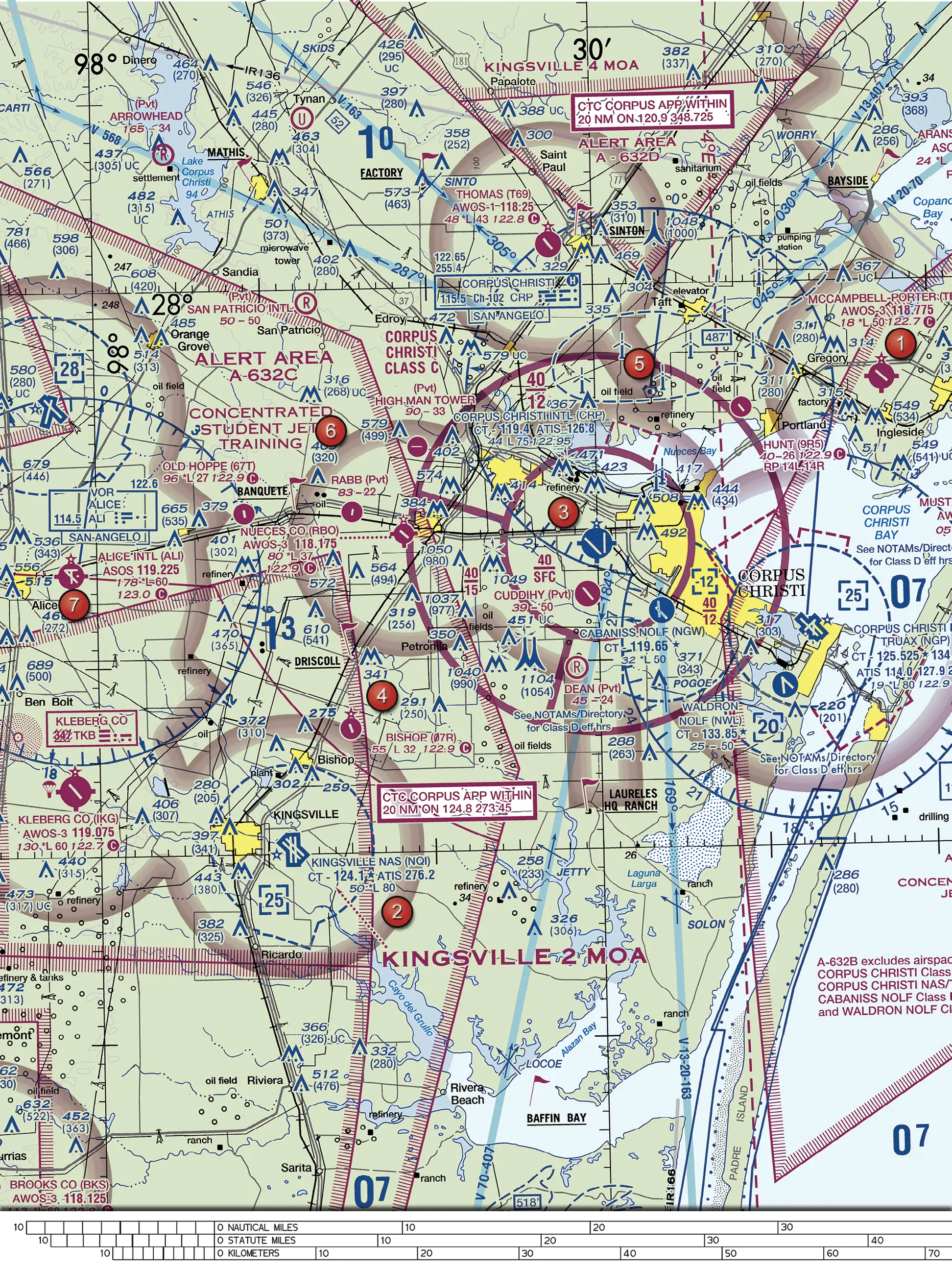
(Refer to Figure 69.) Near Kingsville, an airport is labeled KINGSVILLE NAS (NQI) CT - 124.1. What type of airport does NAS in its name identify?
Figure 69, FAA Airman Knowledge Testing Supplement (FAA-CT-8080-2H). Open full size to zoom. Not for navigation.
AA non-public-use private airport
BA military airport, a Naval Air Station
CA seaplane base
Show answer and explanation
Correct answer: B. A military airport, a Naval Air Station
U.S. military airports are identified by abbreviations such as AAF, AFB, MCAS and NAS. NAS stands for Naval Air Station, so Kingsville NAS is a military airport; the blue data and CT show it has a control tower.
A. Incorrect. Private airports are marked (Pvt); NAS identifies a military airport.
B. Correct. U.S. military airports are identified by abbreviations such as NAS (Naval Air Station).
C. Incorrect. Seaplane bases are shown with an anchor symbol; NAS stands for Naval Air Station.
A remote PIC will film near an accident scene where an EMS helicopter may need the same area the small UA plans to land in. The PIC also expects to be low on power late in the flight. Which mitigation does AC 107-2A describe for this case?
APlan to land in the helicopter's landing area, because the small UA was there first
BPlan an alternate landing site and possibly sites where the small UA can be sacrificed to avoid risk to people or manned aircraft
CKeep the small UA hovering until the helicopter has left, whatever the remaining power
Show answer and explanation
Correct answer: B. Plan an alternate landing site and possibly sites where the small UA can be sacrificed to avoid risk to people or manned aircraft
Thinking through this hazard before flight leads to an alternate landing site and, if needed, places to sacrifice the small UA so it does not endanger people on the ground or manned aircraft.
A. Incorrect. Wrong. Small unmanned aircraft must yield right-of-way to manned aircraft; the plan must include other sites.
B. Correct. AC 107-2A's example mitigates this hazard with an alternate landing site and possible sites to sacrifice the aircraft.
C. Incorrect. Wrong. With power running low, waiting in a hover without an alternate plan may leave no suitable place to land.
Source
AC 107-2A Small Unmanned Aircraft Systems (sUAS), Appendix A, A.4.8.1
A client asks a remote pilot to fly in conditions the pilot considers unsafe. The pilot thinks, "Whatever I decide won't change anything," and agrees just to be a nice guy. Which hazardous attitude is this?
AMacho
BInvulnerability
CResignation
Show answer and explanation
Correct answer: C. Resignation
The resignation attitude ("What's the use?") appears when a pilot feels unable to change the outcome and goes along with unreasonable requests to be a "nice guy." The antidote is: I'm not helpless. I can make a difference.
A. Incorrect. The macho attitude is about taking risks to prove oneself and impress others, not about going along with a request.
B. Incorrect. Invulnerability is the belief that accidents happen only to others ("It won't happen to me").
C. Correct. Resignation pilots feel they cannot make a difference, leave the action to others, and may go along with unreasonable requests just to be a "nice guy."
Source
FAA-H-8083-25C Pilot's Handbook of Aeronautical Knowledge, Chapter 2, Hazardous Attitudes and Antidotes (Figure 2-4)
While monitoring a local frequency, a remote pilot hears traffic from a Cessna Citation business jet registered as N482KT. Following the call sign convention in the FAA study guide, how would its call sign most likely be spoken?
ACessna Four-Eight-Two-Kilo-Tango
BCitation Four-Eight-Two-Kilo-Tango
CSpeedbird Four-Eight-Two-Kilo-Tango
Show answer and explanation
Correct answer: B. Citation Four-Eight-Two-Kilo-Tango
For light GA aircraft, the manufacturer's name usually replaces November. For heavier GA aircraft such as turbo-props or turbo-jets, the model name is used, so a Citation registered N482KT would be Citation Four-Eight-Two-Kilo-Tango.
A. Incorrect. The manufacturer's name is usually used for light general aviation aircraft; for heavier aircraft such as turbo-jets, the model is used.
B. Correct. For heavier GA aircraft such as turbo-props or turbo-jets, the aircraft's model is used in the call sign.
C. Incorrect. Speedbird is the call sign that British Airways uses instead of its company name; it is not used for a privately registered Citation.
Source
FAA-G-8082-22 Remote Pilot – sUAS Study Guide, Chapter 7, Aircraft Call Signs
FAA-G-8082-22 Remote Pilot – sUAS Study Guide, Chapter 7, Aircraft Call Signs
FAA-G-8082-22 Remote Pilot – sUAS Study Guide, Chapter 7, Aircraft Call Signs
Remote Pilot Ace has topic practice, full 65-question mock exams in the test format, zoomable figures and an explanation with its source for every answer. Free to start.
Coming soon to the App Store and Google Play. About the app